07 August 2014

Success in Rio

Reprinted from Focus Magazine, August 2014
Cicely Berry
Image © Ellie Kurtz

“Where words prevail not, violence prevails.”                                                                                               – The Spanish Tragedy, Thomas Kyd
By the time this appears in print, the dust of the FIFA World Cup will have settled, the winning nation will have held the golden trophy aloft (C’mon, Argentina!), and we all shall have re-emerged -- somewhat blurry-eyed, perhaps -- from our collective Brazilian hangover. What, one wonders, shall remain?

A great deal of questioning, no doubt. A certain Uruguayan will be due a period of intensive self-reflection (“To bite, or not to bite, that is question?”), and a considerable amount of collective introspection will be due for the likes of host nation, Brazil, and, of course, England.

Following England’s abrupt departure from the proceedings, I was more disappointed by the players’ reactions than by their poor performance. Wayne Rooney’s apologetic epilogue was utterly disheartening, particularly, his assessment that the English side is “too nice” to win trophies. Rooney lamented England’s lack of “nastiness”, implying that the team should become more ruthless and “street-wise”. That would be very sad, indeed, and quite out of national character.

Fair play and sportsmanship are hallmarks of British mentality and disposition. When outlining characteristics of his beloved English for his fellow Americans in 1904, Ralph Waldo Emerson mused that the most indefatigable English trait was “pluck”. He enthused: “One thing the English value is pluck. The cabmen have it; the merchants have it; the bishops have it; and the women have it!”

Cicely Berry, legendary Voice Director of the RSC, is by far the pluckiest Englishwoman I know. Since 1997, Cicely has traveled to Brazil to collaborate with “Nós de Morro” - a group of theatre artists based in one of Rio’s toughest slums (favelas). Far from the lush, tropical scenery featured on our tellies during the World Cup, Vidigal is a world apart - set high in the hills that surround the beautiful and opulent city. Controlled by drug cartels, replete with guns, gangs, and violence, it is place into which the police do not venture except in armoured cars. Armed with the works of Shakespeare, diminutive, octogenarian Cicely Berry enters this volatile place and competes confidently with drug lords for the hearts, minds and souls of Vidigal’s favelados (young people living in the slums).
As vividly depicted in the brutal, but truthful film City of God (2002), life is cheap in Vidigal. Watching that film, I shuddered at the thought of gentle, precious Cicely traversing such a place. (I once suggested accompanying her, and she resisted on the grounds that she could not guarantee my safety.)

True to herself, and driven by her uncompromising politics, Cicely’s mission is to empower, liberate and give voice to the voiceless. For Cicely, Shakespeare’s words are apt channels of expression, and by freeing the voice through his full, rich and powerful language, the speaker ultimately develops the courage and freedom to fully express their inner self. Hers is a truly characteristically English ‘plucky’ success in Rio, and one well worth celebrating!

15 June 2014

Fathers, Sons, and Wars


Lately, I have been thinking a lot about fathers and sons. Recent events, of both private and public varieties, have prompted fresh thoughts about this primordial dynamic. Becoming a parent has a way of re-tuning the mind to see familiar concepts in a new light. Watching my “Darling English Boy” evolve into a “Darling English Dad” has given me a renewed respect for fathers and fatherhood.

Just before the arrival our son, Miles, I became obsessed with family history. I was intrigued to find that my husband descends from an exclusively male lineage on his father’s side. His paternal history, like that every Englishman, is a rich tale of fathers, sons, and wars.

In May 1916, my husband’s grandfather, Russell, enlisted in the Army and joined the British effort in “The Great War”. He was but 19 years of age. Yet, the sure and steady longhand and precise signatures that appear on his enlistment form suggest maturity beyond his tender years.

British Legion 'Poppy Field' in Henley-in-Arden
He gave particular care and attention to the signing of his ‘Oath of Allegiance’. The “t” is most carefully crossed, both “i’s” firmly dotted, and a plump full stop appears definitively to the rear of the concluding character. The document exudes sincerity, duty and pride. Russell was a brave soul, amongst a host of similarly valiant youth that answered the call of King and Country. However, unlike the multitude of his fellow brothers-in-arms, Russell was one of the lucky ones that survived. As Shakespeare puts so well, “This story shall the good man teach his son” (Henry V, 4.3.56).

Shakespeare, of course, knew a thing or two about fathers, sons, and wars. His works are a vast reservoir of engaging stories on this theme. His history plays, in particular, are built upon this foundational concept. Most notably, in Henry the Sixth, part 3, Shakespeare underscores the maddening nature of war through his invention of two tragic and un-named characters, referred to merely as: “A Father who has killed his son” and “A Son who has killed his father.” Time and again, Shakespeare shows us the human cost of national conflicts, and the familial relationships behind the power play.

Recently, I had the good fortune to see Greg Doran’s excellent production of Henry IV, parts 1 and 2 at the RSC. At the heart of this narrative exists the triadic relationship of King Henry, Prince Hal and Falstaff. Troubled son, Hal, turns his back on his duty and his sovereign, by displacing his regal father in favour of a low life surrogate in the figure of Falstaff. In performance this complex choice is played with great, rollicking humour and touching pathos by Jasper Britton (Bolingbroke/King Henry) and Alex Hassell (Prince Hal), with Sir Antony Sher stealing the show as the roly-poly, custardy coward, Falstaff.

Alongside the engaging performances, Doran’s direction is crystal clear, making the grand narrative easy to follow. It was, in very deed, child’s play. I was seated next to a little chap called Gregor Bulmer, aged 8, who was at the theatre with his dad. They huddled together during the ferocious battle scenes, and the young lad was enrapt by the performances from start to finish. As the lights came up, Gregor gave his assessment: “Epic.” I asked if he understood it all, he smiled and said he had.


The epic tales of fathers, sons, and wars will always captivate us and command our attention and respect. And so they should, as we should never forget.  

23 April 2014

Happy Birthday, Mr Shakespeare!


The title of my popular, New York University undergraduate seminar, “American Shakespeare”, always raised a few eyebrows. “It’s a survey of Shakespeare in America,” I once explained to a stuffy, Oxbridge colleague. “But,” he sniffed, “Shakespeare was never in America.” “Indeed,” I replied heartily, “but he is very much with us now.”

My seminar examined what Emerson termed the “Shakespearization” of America. I had no idea where this exploration might lead. And, certainly never imagined I would find myself re-discovering Shakespeare in a tiny, fishing village in southern Alaska.

That excursion began with a dare. One day, I sauntered into class with a topic I knew my students would be keen to devour. I’d found details of a production of Othello in Alaska. The play had been adapted into a 19th century, Alaskan context. Othello became a Native Alaskan, instead of a Moor. The goal of this touring show was to facilitate dialogue between Native and non-Native communities.

Can, or should, Shakespeare be used in this way? My students, as always, were hotly divided between the purists and the progressives. Reaching a fevered pitch, they demanded I settle the debate: “Dr. Smith-Howard, you must go there and find out.” They dared, and, off I went.
I wrote the theatre company and asked if I could observe their work. Next thing I knew, I was flying over the Rocky Mountains, to the vast, wild, least populated, and most breathtaking state in the American union.

The experience that followed was an incredibly powerful one, and one that underscores for me the discernable differences in what Shakespeare means today. One facet of Shakespeare’s inheritance is that he has become a trusted brand. His name, image and words are used to market and sell a staggering array of goods around the globe, from the Shakespeare Coffee Company (Bidford-on-Avon), “Hamlet” Cigars, and Austin motor-cars (“Travel…as you like it.”) in Britain, to mentholated cough syrup in Brazil (“To Coff, or not to coff, that is the question”).

In contrast is the esteem in which Shakespeare is held in America, where he is perceived as a touchstone, a symbol of artistry and wisdom. Americans seem to have accepted as gospel the 19th century, British notion of Shakespeare’s secular godship. Joseph Papp, America’s foremost theatre director, put it best:

Why do so many people get hooked on Shakespeare and develop a habit that lasts a lifetime? What can he really say to us today, in a world filled with inventions and problems he could never have imagined? Because, Shakespeare is showing you human nature. Shakespeare has enriched my understanding of life immeasurably. I hope you’ll let him do the same for you.”  (Shakespeare Alive!, 1988)
Like Papp, I, too, have experienced the transformative power of Shakespeare in people’s lives: from disadvantaged teens in NYC to Native American elders in rural Alaska. I have witnessed Shakespeare’s words empowering the voiceless; and being the common language differing cultures previously lacked. I have seen his texts creating a common ground, a campfire around which a divided community could gather. For me, this is his greatest and most enduring legacy. 

Happy Birthday, Mr. Shakespeare, wherever you are!


18 March 2014

My new DEB - Darling English Baby!

"O, brave new world, that has such creatures in it!" - The Tempest


Miles Jude Willoughby
born 16 January 2014

17 March 2014

On the Road with “The Writing Process Blog Tour”


Friends,

Apologies for the extended absence - and a huge, huge, huge THANK YOU to Jenefer Heap for nudging me back into the Blogsphere.

My life has been a whirlwind recently, and blogging, although firmly ensconced on the “To Do” list, never quite made it to the top of the page. Taking part in the “Blogging Tour” has however re-ignited the flame!

Each writer in the Blogging Tour is invited to answer the same four questions about their writing, thus forming a new link in a long and winding virtual chain. I’m one of three writers taking the baton from Jenny (she writes a great blog, check it out: Jenefer Heap ). 
The three witty and engaging writers I’ve chosen to follow me next week are: Caroline BarrHarriet Hamilton and The Girl Behind The Wall. I love their work, and I’m sure you will, too! Read more about them at the end of the blog.
 And, so. Placing myself into the ‘hot seat’…

Question 1: What am I working on?

1.) At the moment, I am focused on two main projects (well, three, if I can count our 2 month old baby as a project!):

a.)           I’ve blissfully landed a commission for a book to commemorate the major Shakespeare anniversary in 2016. (He died in 1616.) For this, I shall be collaborating with a major UK arts organisation, and we are currently pursuing funding and support. (Would be benefactors welcome!) 
            
            I’m utterly delighted to have the opportunity and hope that the book will bridge both scholarly and popular interest in Shakespeare and his legacy. I’m loathed to provide more specific details about it here for fear of jinxing things (!), as we are still hashing through details, contracts, etc. Suffice to say, the project is very “me”, i.e.,  embracing a range topics under one big, glorious Shakespeare umbrella! I’m still in the honeymoon phase, but the panic of actually having to produce something quite substantial by January 2015 is looming large on the horizon…

b.)           For the past 4 years, I have had a regular, featured column in a glossy, monthly magazine. Sadly, the magazine folded (not due to my column, I hasten to add!) and now, after several weary months of crying into my beer, and feeling sorry for myself, I’m in the process of trying to re-establish myself as a columnist-in-print. (Short of standing on the side of the road with a sign that reads: “Will Write for Food.”)

2) How does my work differ from others of its genre?

I think what makes me different both as a scholarly writer and a popular writer is the quirky way in which I don’t divide the two. For better or for worse, I approach all of my work in the same way. I try to write with heart, tenacity, verve, humour, and knowledge.

In terms of my scholarly work – I’m the author of three works of scholarly non-fiction: 


With each of these works my goal was to tell a complex story simply. To be accessible and entertaining, whilst also being true to the subject. The same is true of my work as a columnist and op-ed writer.

Undoubtedly, the most unique feature of my writing is the way in which Shakespeare quite honestly informs everything I do. I see the world through a Shakespearean lens. That, I suppose, is my “twist”.

Recently, I collaborated with Chef and culinary historian, Alan Deegan on a Shakespeare cookbook!


Question 3: Why do I write what I do?

“Words, words, words.” - Hamlet

When Shakespeare isn’t looking, I allow myself to canoodle with a few other authors, notably Chekhov. In his play, The Seagull, in which he is channeling Shakespeare (!), Chekhov depicts one of the most beautiful and infuriating representations of a writer in the character, Trigorin.

Trigorin is passionate, flawed, wounding, and vulnerable.  When asked why he pursues his craft, he states quite simply, and with a slight air of defeated resolve: “I have to write. I have to write. I have to write.”

Writing in this instance is an undeniable need. This is a need I understand.  For me, writing is a way of being in the world, of living, seeing, and making sense of it all.

I was once warned of the potential hazards of becoming an “academic gadabout”. Ironically, at the time this warning was issued, the speaker in question – a rather somber, but well-meaning academic Dean – actually used the wrong word. She advised me against becoming a “Gadfly”, though I’m in no doubt she meant “Gadabout”, as it became very clear that from her perspective, being a “Gadfly” (a person who annoys or criticises others) is preferable to being a “Gadabout” (a person who flits from place to place, thing to thing). The notion, it seems, is that it’s okay to ruffle feathers, as long as you only ruffle the very same set of feathers relentlessly, and without deviation.

Well, where’s the fun in that?

Not one for warnings or omens, I have happily embraced my “Gadaboutness” and it has brought me much joy, and is in fact a key feature of my preferred genre as a columnist. Far from the confines of academe, I write about any and everything I will! From sausages and oysters, to probate and wills, to Shakespeare and stage history.

Question 4: How does my writing process work? 

“If it be madness, yet there is method in it.” - Hamlet

Process? What process?

This is the greatest thing about being a columnist. To quote Shakespeare (yet again!): “The world is mine oyster.” Everything is source material - ‘the story’ is everywhere. So really the process begins with observation. Seeing, but seeing in a different way. Not actively “looking for the story”, but always, always being open to the story.  Being a sponge is also important, and goes without saying. Being brave, fearless, and a bit mad. Not being afraid to put your heart and soul on the page.

In terms of practical mechanics, when I was actively working on my monthly column (sniff, sniff!) the deadlines were precise and tight. I work well under pressure, so it helped to have that relentless drive of “It’s due, it’s due!!” The perfect day would be sitting out on the deck, basking in the sunshine, with a huge mug of Assam tea, thinking – “What shall I write about this month…?” 
(Those were the days. *SIGH*)

I am/was constantly making notes, scribbling and blogging is indispensible. (Though I’ve been very very remiss in that area of late.)

But thank you, again and again, to Jenefer Heap for nudging me back onto the screen!

Now, without further ado, I’d like to introduce you to three of my writer friends who I've selected to carry the baton for next week’s Blogging Tour...
Caroline Barr

Blog: "Ask A Busy Woman"

Caroline Barr has spent a lifetime in marketing and public relations, plus 4 children, husband, dogs, tennis playing, rugby watching, and golf learning. She has just completed her first novel. Her superbly titled blog, "Ask a Busy Woman" is centred on her life in Yorkshire. 

***********************

Lady Harriet Hamilton

Blog: Lady Harriet Hamilton
We own and run the apley estate in Shropshire,  a 8500 acre working country estate where we opened apley farm shop in 2011, Apley walled garden in 2013 and 3 apley holiday cottages between 2007-2012. I do the marketing, pr and advertising for those businesses,  as well as focussing this year on the Apley archives. 

My blog is principally to write about anything going on at Apley as well as some personal blogs too, as it's very much a family business. The farm shop site has 9 businesses and the estate itself is also very Multi facetted, incorporating rented properties, shoots and farming. 

************************************************************************


The Girl Behind the Wall

The Girl Behind The Wall

Blog: My Mending Wall

As a survivor of abuse and neglect, I am on a journey of sorting out the whys and hows. My life began in the midst of turmoil, but will end in peace and serenity because I choose not to be a victim, but rather I choose a journey of healing the unseen scars of my childhood.

03 January 2014

Ties that bind

Without a doubt, pregnancy has a way of focusing the mind.
During this period of creating and shaping new life, my thoughts have returned repeatedly to the concept of "Family". A concept that also features quite prominently -- in good ways, and bad -- this time of year.

Living, as I choose to, far from my biological family, I ever reminded and reassured of the vital importance of our "families of choice" -- the families and communities we choose and create for ourselves.

These associations and attachments and made openly, freely, fully and honestly, and serve great purposes in our lives. Connecting us to a larger and far more dynamic world, than the often tiny society of shared DNA.

Several years ago, whilst on a great Shakespeare adventure in Alaska, America's most vast and sparsely populated state, I was adopted into the Eagle Clan of the T'lingit tribe. A world of away from my rough-and-tumble New York City life, I'd immediately felt at home with the people of Yakutat, a lovely, remote fishing village in southeastern Alaska. The feeling was apparently mutual.

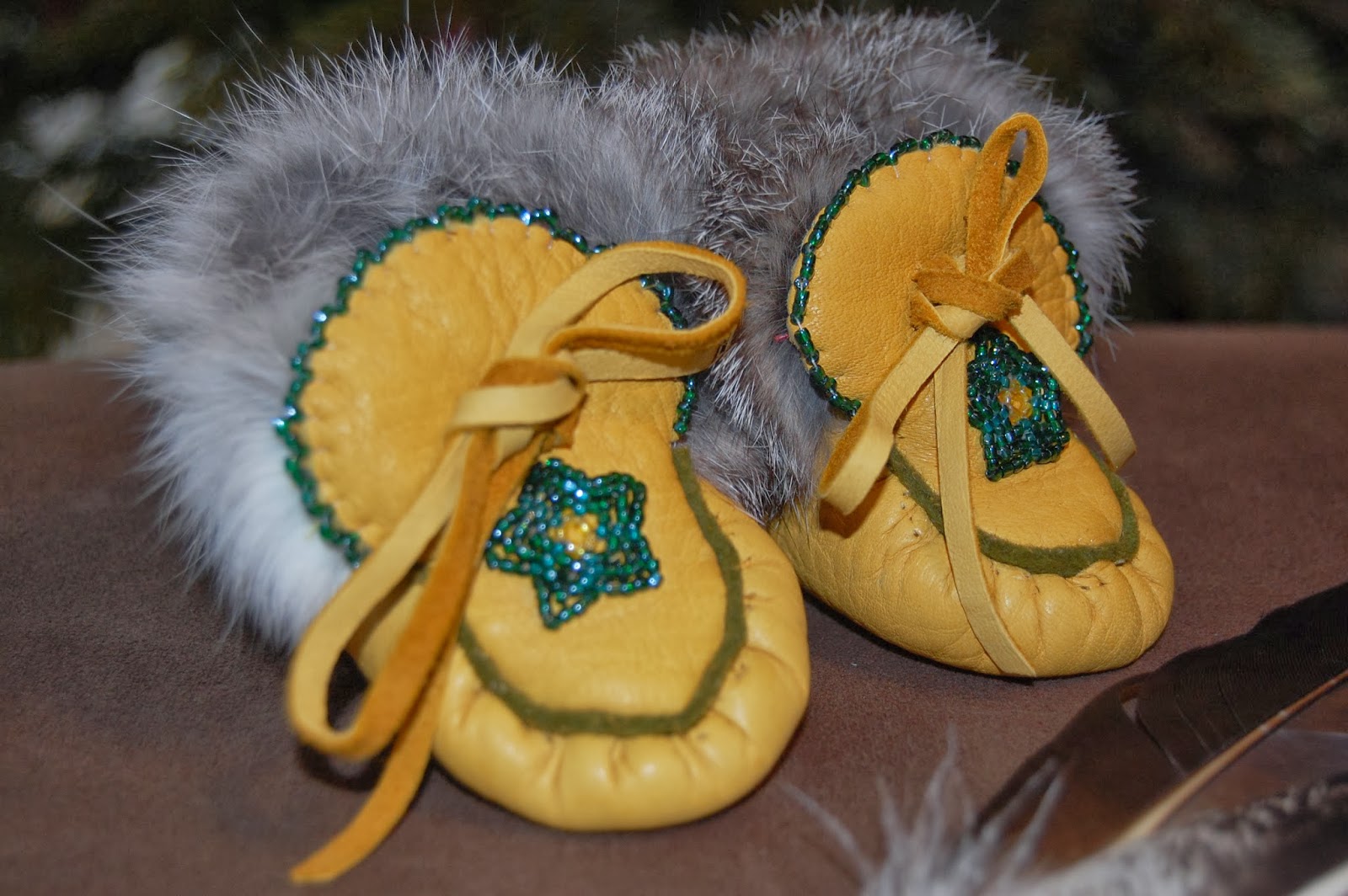
Today, a parcel arrived from my tribal sister, Inga, with Eagle Clan gifts for the DEB, Baby and me in advance of the new arrival. It included 3 Eagle feathers - one for each of us, as a reminder of our lineage. And, the most adorable pair of hand-made baby moccasins you ever did see!


I cannot wait to share with this child how loved he or she already is by a remarkable, extended global family.